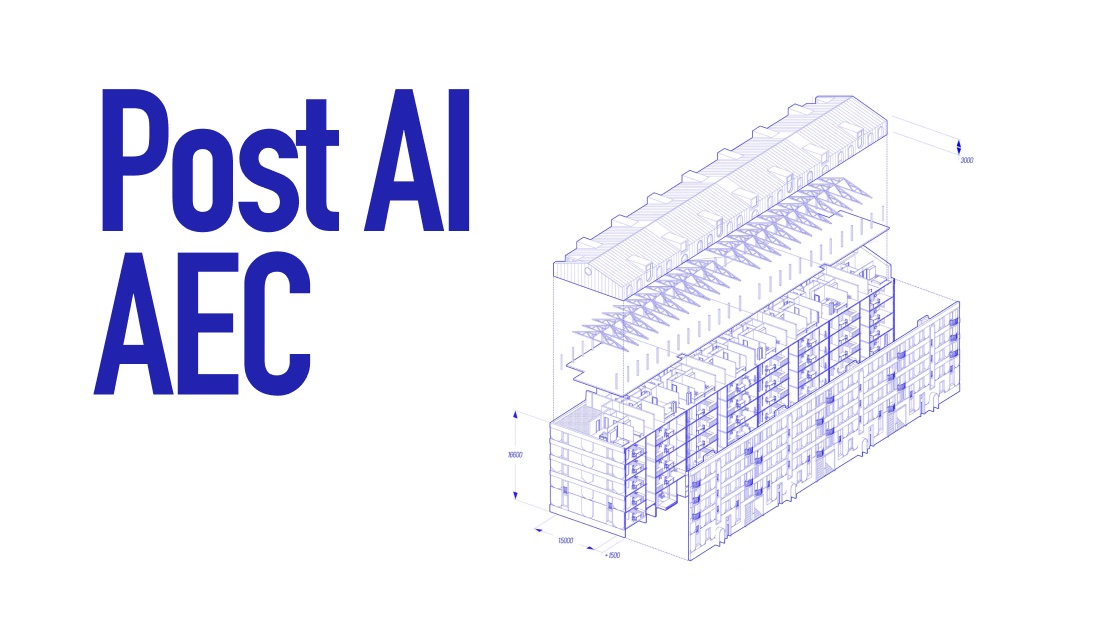
The recent a16z article “Every building you’ve ever been in was designed by software built in 1997” resonated deeply with us as a team building in AEC.
Not because we think Revit is going away tomorrow. But because we think the real opportunity sits somewhere else in the process.
At Synaps, we are not trying to replace Revit. At least not today. And that is a deliberate decision.
Where existing tools are actually very good
One mistake startups often make is assuming incumbents survive because markets are irrational.
Revit survives because it does certain things extremely well:
- Parametric documentation
- Coordination across disciplines
- Enterprise workflows
- Complex building data management
These are not easy problems. And replacing that stack head on is not where most successful disruption stories begin.
History shows something different. Disruption opportunities lie where incumbents are weakest, not strongest.
The part of architecture software that feels unfinished
Where we see the biggest gap is not in construction documentation. It is earlier, already starting in schematic design. The exact process that is iterative, explorative and where building are still fluid and taking shape.
This is exactly the phase where architects need to move fast and explore heavily without locking into heavy models and parameters. Sometimes even as unpaid labor since the contract may not have been secured yet.
Ironically, this is also where most creativity happens.
This is arguably the most important process of building design and the part where most questions are answered.
Yet, fully neglected by Revit (and arguably the only reason AutoCAD still exists).
Why we chose to start in 2D
Synaps today is a 2D environment by design. Not because we don’t believe in 3D or BIM but because we believe software should match the phase of work it serves.
Early design is still fundamentally about:
- Spatial relationships
- Circulation
- Program
- Structure logic
- Communication clarity
2D remains the fastest medium for thinking through these problems.
Adding full BIM complexity too early often slows the exact workflows we think should be accelerated.
So instead of starting with full building modeling, we started with a simpler question: How fast can architectural thinking move if the software gets out of the way?
Starting where most buildings actually begin
Our strategy at Synaps is to start where the majority of architectural work actually happens, not where the software industry traditionally focuses.
Most buildings do not begin as complex BIM models. They begin as iterative floor plans, spatial diagrams or layouts.
And for a large portion of the market (especially small and midsized firms) full BIM environments are often excessive for this phase. They introduce structure and parameters before exploration is finished.
In most cases, it is simply overkill.
We believe this creates a large and underserved layer of the market. We need early stage design workflows that move fast but still produce outputs that can flow downstream without friction.
This is the layer we are focused on.
Owning the AI layer of early design
We believe AIs biggest nearterm impact in AEC will come from removing the burden of manual drafting.
Not the architectural decisions themselves, but the mechanical work software still requires just to express those decisions.
Today, a surprising amount of architectural time is still spent not on design, but on translating intent into geometry:
- Filling property panels just to draw a simple wall
- Managing joins and constraints after every small change
- Re-entering the same information over and over again
- Tracing over existing plans just to get to point 0.
This process shouldn’t be human and definitely not an architects job. Exactly this manual complexity fragments the industry.
This is the kind of work we believe AI should absorb first, not creativity, not authorship, but the translation layer between architectural intent and the geometric model.
If software can understand what the creator is trying to build, it should not require them to manually construct every line, constraint, and parameter needed to represent it.
At Synaps we are shifting the burden of geometric construction, parametric bookkeeping, and repetitive modeling from the architect to the system.
Integrating with BIM instead of replacing it
Rather than positioning ourselves as a BIM replacement, we see a more practical path: Becoming the lead environment before BIM.
And then making the transition into BIM frictionless.
Instead of forcing firms to change their entire stack, we think the better strategy is compatibility: Allow architects to work where speed matters. Allow BIM to take over where complexity matters.
Make the handover seamless.
This is why interoperability with Revit and similar systems is a core part of our longterm thinking.
If early design can produce structured outputs that flow cleanly into BIM, the boundary between “schematic tool” and “documentation tool” starts to dissolve.
The opportunity is not necessarily to replace existing systems immediately. It may be to quietly become upstream of them.
Getting BIM-level outputs without BIM-level friction
One of the questions guiding our roadmap is: Can modern AI allow simpler tools to produce outputs that previously required complex software?
Historically, powerful output required complex interfaces but AI is changing that relationship.
If AI can assist documentation, structure geometry, and automate preparation steps, then the complexity required to reach production grade outputs may decrease significantly.
This suggests a different kind of design tool may become possible: Tools that remain simple on the surface, but produce increasingly sophisticated results underneath.
If there is one longer term belief shaping how we think about Synaps, it is this: The best interface for complex software may be no interface at all.
Ironically fits with the Mies motto- Less is more.
At Synaps, our beta launch gave us an early signal, 50k users in 4 months suggested this direction resonates. This summer, we are taking the next step toward that vision.
Not by adding complexity. But by continuing to remove it.